


What Is an Acoustic Imaging Camera? How It Helps Detect Compressed Air & Gas Leaks
Compressed air and pressurised gas systems are essential to many industrial operations.
Unfortunately, leaks can develop at fittings, valves, hoses, connectors, seals and other components—and small leaks are not always easy to locate in a noisy production environment.
A leak may continue unnoticed while compressed air or gas escapes continuously, potentially increasing energy consumption, reducing system efficiency and placing additional demand on compressors and associated equipment.
Traditional leak detection methods can also require technicians to inspect components individually.
An acoustic imaging camera provides a different approach.
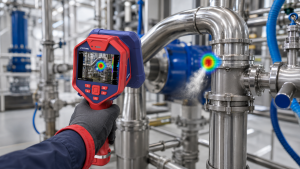
Instead of searching for a leak point-by-point, acoustic imaging technology allows maintenance teams to visualise where sound is coming from, helping technicians locate compressed-air, pressurised-gas and vacuum leaks quickly and without physical contact.
What Is an Acoustic Imaging Camera?
An acoustic imaging camera is an inspection device designed to locate and visualise sound sources.
Unlike a conventional camera that captures visible light or a thermal camera that detects infrared radiation, an acoustic camera uses an array of microphones to detect sound arriving from different directions.
Advanced processing algorithms analyse these acoustic signals to determine the direction and location of the sound source.
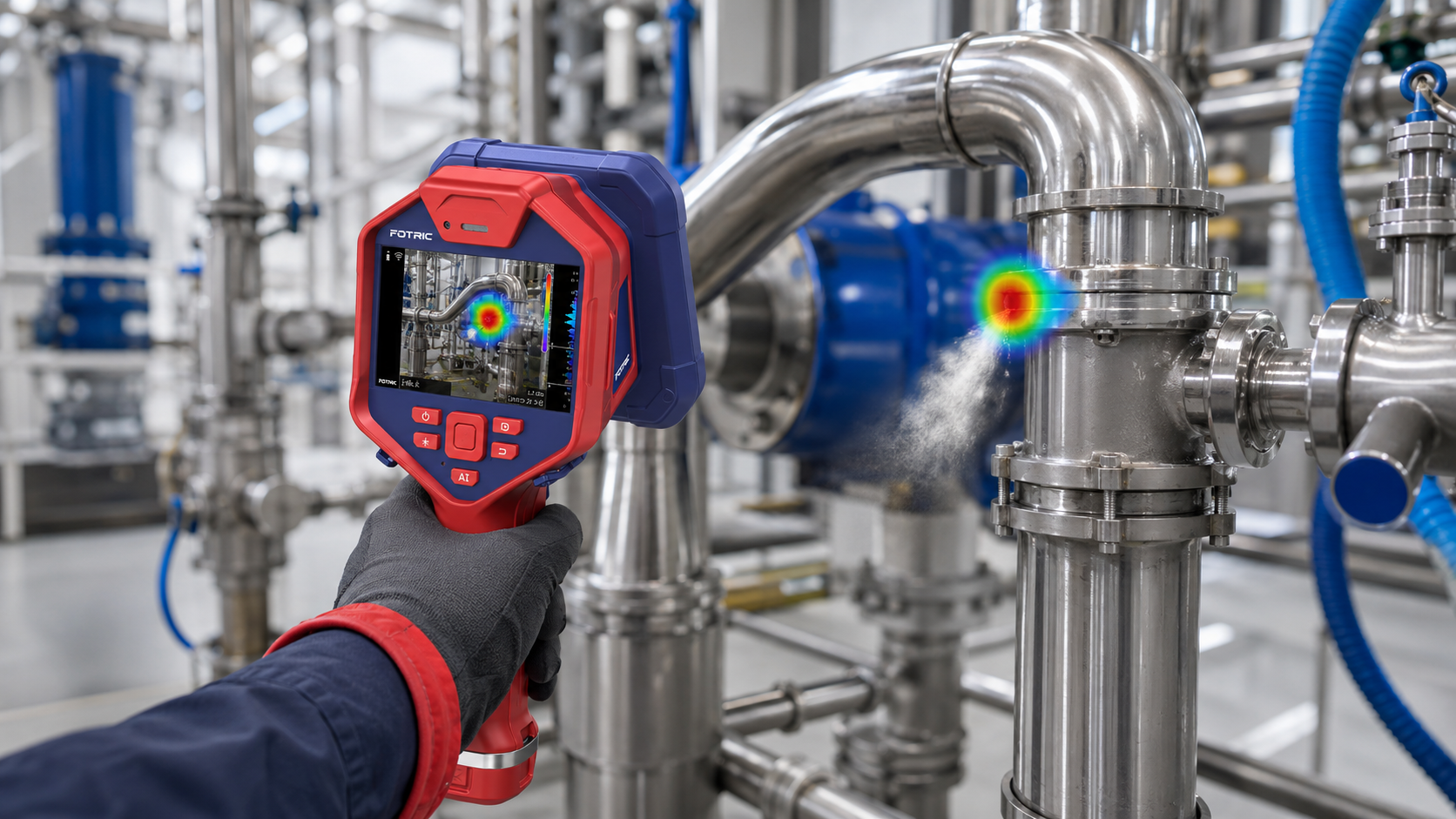
The result is then displayed visually—typically as a coloured acoustic map overlaid on a normal digital image.
In simple terms:
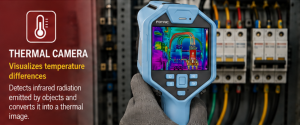
A thermal camera helps you see heat.
An acoustic imaging camera helps you see sound.
This ability is particularly valuable for industrial maintenance because escaping compressed air and pressurised gases can generate acoustic and ultrasonic signals that may be difficult—or impossible—for technicians to identify reliably by hearing alone.
How Does an Acoustic Imaging Camera Work?
An acoustic camera generally combines three important technologies:
- Microphone Array
Instead of using a single microphone, an acoustic imaging camera uses multiple microphones arranged in an array.
Each microphone receives sound from the environment.
Because sound from a particular source reaches different microphones at slightly different times and intensities, the system can use these differences to determine where the sound originated.
- Acoustic Signal Processing
The camera processes signals received by the microphone array using techniques such as beamforming.
Beamforming helps the system focus on sound arriving from particular directions and locate the source.
This is especially useful in industrial environments where multiple machines may be operating simultaneously.
- Visual Sound Map
After identifying the acoustic source, the camera overlays the location onto a visible-light image.
Instead of telling the technician simply that ultrasonic sound exists somewhere nearby, the display can show where the sound is coming from.
This transforms an invisible acoustic signal into information that technicians can see and act upon.
Why Do Compressed Air Leaks Matter?
Compressed air is widely used throughout manufacturing and industrial facilities.
Typical applications include:
- Pneumatic tools
- Production machinery
- Air cylinders
- Control valves
- Packaging equipment
- Automation systems
- Instrumentation
- Cleaning operations
- Material handling equipment
Producing compressed air requires energy.
When a leak develops, part of that compressed air escapes without performing useful work.
A facility may therefore be paying to compress air that is continuously being lost.
One small leak may not appear significant.
But when multiple leaks exist across a large compressed-air network, the cumulative energy loss can become substantial.
This makes compressed air leak detection an important part of industrial energy management and preventive maintenance.
Where Do Compressed Air Leaks Commonly Occur?
Leaks can develop anywhere within a compressed-air system, but common locations include:
Pipe Connections
Threaded and mechanical connections can deteriorate or loosen over time.
Pneumatic Fittings
Push-in fittings and connectors are frequently used throughout industrial pneumatic systems and can become potential leakage points.
Hoses
Flexible hoses can develop cracks, wear or damage.
Valves
Valve seals and internal components can deteriorate and allow air to escape.
Pneumatic Cylinders
Cylinder seals may wear over time, resulting in leakage.
Couplings
Quick-connect couplings experience repeated connection and disconnection and may develop leaks.
Filters, Regulators and Lubricators
Connections and seals around air preparation equipment can also become leakage points.
Equipment Connections
Leaks can occur where compressed-air supply lines connect to production equipment.
With hundreds or thousands of pneumatic components potentially distributed throughout a facility, locating every leak manually can be challenging.
This is where acoustic imaging becomes particularly useful.
How Acoustic Imaging Helps Detect Compressed Air Leaks
Compressed air escaping through a small opening produces turbulence.
This turbulent flow generates sound, including high-frequency acoustic energy.
An acoustic imaging camera detects these sound signals and determines where they originate.
The technician can scan pipework, valves, pneumatic components and production equipment from a distance.
When the camera identifies a relevant acoustic source, it displays the location on the screen.
Instead of inspecting every fitting individually, maintenance teams can use the camera to screen a larger area and quickly identify potential leakage points.
Can Acoustic Cameras Detect Gas Leaks?
Acoustic imaging can also be used for certain pressurised gas leaks.
When pressurised gas escapes through an opening, the resulting turbulent flow can generate detectable acoustic and ultrasonic signals.
An acoustic imaging camera can locate these signals and visually indicate the source.
Depending on the application, acoustic imaging may be useful for inspecting:
- Pressurised gas pipelines
- Valves
- Flanges
- Fittings
- Connectors
- Regulators
- Process equipment
- Pneumatic systems
However, it is important to understand what the camera is actually detecting.
An acoustic imaging camera detects the sound generated by a leak—it does not chemically identify the gas itself.
Where gas identification, concentration measurement or safety monitoring is required, appropriate gas-detection instrumentation and site safety procedures must still be used.
Acoustic imaging should therefore complement—not replace—required gas safety systems.
Can Acoustic Imaging Detect Vacuum Leaks?
Yes, acoustic imaging can also be useful for locating certain vacuum or negative-pressure leaks.
The principle is similar, although the direction of airflow is reversed.
Instead of compressed air escaping from the system, surrounding air may be drawn into a vacuum system through an unintended opening.
This airflow can produce acoustic signals that the camera can locate.
Potential applications include inspection of vacuum lines, fittings, seals and associated process equipment.
Why Not Simply Listen for the Leak?
A large compressed-air leak may be audible.
The difficulty is that factories are rarely quiet.
Industrial environments can contain sound from:
- Motors
- Pumps
- Fans
- Compressors
- Conveyors
- Production machinery
- Pneumatic equipment
- HVAC systems
- Vehicles
Trying to identify a small air leak by hearing alone can therefore be difficult.
Some leak-generated signals also occur at frequencies beyond normal human hearing.
Acoustic imaging technology allows technicians to focus on relevant frequency ranges and visually locate sound sources.
This makes leak detection much more systematic than simply walking through a facility and listening for a hissing sound.
Acoustic Camera vs Traditional Ultrasonic Leak Detector
Handheld ultrasonic detectors have been used for leak detection for many years.
These instruments can be effective, but the inspection method is different from acoustic imaging.
With a traditional ultrasonic detector, technicians typically move a probe or sensor around equipment and use the instrument’s reading or headphones to determine whether they are getting closer to the leak.
This can work well when the approximate leak location is already known.
An acoustic imaging camera provides a broader visual approach.
The technician can scan an area and see where relevant sound sources are located on the image.
Traditional Ultrasonic Detector
Best suited for targeted, point-by-point investigation.
Acoustic Imaging Camera
Best suited for rapidly scanning larger areas and visually locating potential sound sources.
The technologies are not necessarily competitors. They can complement one another depending on the maintenance workflow.
Acoustic Imaging Camera vs Thermal Imaging Camera
Thermal and acoustic cameras detect completely different physical phenomena.
A thermal imaging camera detects infrared radiation and visualises temperature differences.
An acoustic imaging camera detects sound and visualises sound-source locations.
That makes them suitable for different maintenance problems.
Thermal Imaging Is Commonly Used For:
- Electrical hotspot detection
- Electrical switchboard inspection
- Overheating components
- Motors and mechanical equipment
- Building inspection
- Temperature measurement
- Process monitoring
Acoustic Imaging Is Commonly Used For:
- Compressed air leak detection
- Pressurised gas leak detection
- Vacuum leak detection
- Pneumatic system inspection
- Abnormal sound localisation
- Certain mechanical anomalies
- Partial discharge inspection with suitable equipment
A maintenance department may therefore benefit from having access to both technologies.
One camera helps technicians see abnormal heat.
The other helps technicians see abnormal sound.
Together, they provide complementary information for predictive and preventive maintenance.
Benefits of Acoustic Imaging for Industrial Leak Detection
Faster Inspection
Technicians can scan multiple components and larger areas rather than checking every possible leakage point individually.
Non-Contact Inspection
Potential sound sources can be located from a distance without touching the equipment.
Inspection During Operation
Many compressed-air and gas systems can be inspected while operating, allowing technicians to identify leakage under actual operating conditions.
Visual Identification
The acoustic map helps users understand exactly where a detected sound source is located.
This makes findings easier to document and communicate to maintenance personnel.
Detection of Ultrasonic Signals
Acoustic imaging systems can detect frequencies outside normal human hearing, helping reveal leaks that may not be obvious to an operator.
Improved Maintenance Prioritisation
Instead of replacing components based solely on a schedule, maintenance teams can identify actual leakage points and prioritise corrective action.
Acoustic Imaging and Energy Efficiency
Compressed-air leak detection is not only a maintenance issue.
It is also an energy-efficiency opportunity.
A compressor must consume energy to produce compressed air.
If part of that air escapes through leaks, additional compressor capacity may be required to maintain system pressure and satisfy production demand.
Finding and repairing leaks can therefore help organisations improve the efficiency of their compressed-air systems.
A structured programme could involve:
- Surveying the facility with an acoustic imaging camera.
- Identifying and documenting potential leakage points.
- Prioritising leaks for repair.
- Repairing the affected fittings, hoses, valves or components.
- Rechecking repaired areas.
- Repeating surveys periodically.
Rather than treating leak detection as a one-time project, facilities can incorporate it into routine energy and maintenance programmes.
Example: Finding an Air Leak on a Production Line
Consider a manufacturing plant with a large pneumatic production line.
Operators notice that the compressor appears to be running frequently, but there is no obvious major air leak.
A maintenance technician begins inspecting the production area using an acoustic imaging camera.
The technician scans pneumatic valves, hoses, fittings and cylinders while production continues.
The acoustic image identifies a concentrated sound source around a pneumatic fitting.
From several metres away, the technician can already see the approximate location of the suspected leak on the camera display.
The maintenance team records the location, inspects the fitting according to the site’s maintenance procedures and performs the required repair.
Afterwards, the area can be scanned again to verify whether the abnormal acoustic source remains.
This illustrates one of the main advantages of acoustic imaging:
the technician does not need to know where the leak is before beginning the inspection.
The camera helps locate it.
Using Acoustic Imaging for Preventive and Predictive Maintenance
Leak detection becomes more valuable when it is performed systematically.
Facilities can establish routine inspection routes covering:
- Compressor rooms
- Main compressed-air lines
- Production lines
- Pneumatic machinery
- Valve stations
- Process equipment
- Utility areas
- High-consumption equipment
Potential leaks can be photographed, recorded and assigned for corrective action.
Repeated inspections can then help maintenance teams identify new leakage points before they remain unnoticed for extended periods.
Acoustic imaging therefore supports the broader transition from reactive maintenance toward condition-based and predictive maintenance.
FOTRIC Acoustic Imaging Cameras
FOTRIC develops acoustic imaging technology for industrial inspection, leak detection and condition monitoring.
FOTRIC acoustic cameras use microphone arrays and acoustic processing technology to transform sound sources into visual information, allowing technicians to locate abnormal acoustic signals quickly.
Depending on the model and application, FOTRIC acoustic imaging solutions can support tasks such as:
- Compressed air leak detection
- Pressurised gas leak detection
- Vacuum leak detection
- Pneumatic system inspection
- Mechanical anomaly detection
- Partial discharge inspection
For example, the FOTRIC TD2e Acoustic Imaging Camera uses a 64-MEMS digital microphone array to capture acoustic information and visually locate sound sources.
It covers both audible and ultrasonic frequency ranges, allowing technicians to identify different types of industrial acoustic anomalies.
For more demanding inspection applications, FOTRIC also offers higher-performance acoustic imaging solutions with larger microphone arrays and additional analysis capabilities.
Choosing an Acoustic Imaging Camera
When evaluating an acoustic imaging camera for industrial leak detection, consider several factors.
Number of Microphones
The microphone array is central to acoustic source localisation.
Different systems use different microphone counts and array designs depending on the required sensitivity and application.
Frequency Range
Industrial leak detection often involves high-frequency and ultrasonic signals.
The camera should cover an appropriate frequency range for the intended application.
Detection Distance
Consider how far technicians typically stand from the equipment being inspected.
Large industrial facilities or difficult-to-access equipment may benefit from longer detection distances.
Noise Suppression
Factories can contain significant background noise.
Features designed to focus on target acoustic signals and suppress interference can improve inspection effectiveness.
Display and Visualisation
The acoustic overlay should make it easy for technicians to understand where the detected sound is coming from.
Reporting Capabilities
For maintenance programmes, the ability to document findings, store acoustic images and prepare inspection records can improve workflow.
Portability
For technicians performing long inspection routes, camera weight, battery life and ergonomics are practical considerations.
Building a Compressed Air Leak Detection Programme
Purchasing an acoustic camera is only the beginning.
To achieve greater value, organisations should consider establishing a structured leak-management programme.
Start by identifying major compressed-air users and establishing inspection routes.
Conduct an initial survey to identify leakage points.
Record each leak with its location, equipment identification and supporting acoustic image.
Prioritise repairs according to severity and operational requirements.
After repair, verify the location again.
Finally, schedule periodic follow-up inspections.
Over time, this creates a repeatable process for identifying and reducing compressed-air losses.
See What You Cannot Hear
Industrial maintenance teams have traditionally relied heavily on what they can see, hear and physically measure.
Acoustic imaging adds another dimension.
It transforms sound—including high-frequency sound that may be difficult for people to hear—into a visual indication that technicians can quickly understand.
For facilities with extensive compressed-air, pneumatic, vacuum or pressurised-gas systems, this can make leak inspection faster and more systematic.
Instead of asking:
“Can you hear a leak somewhere?”
maintenance teams can ask:
“Can we see exactly where the sound is coming from?”
That is the fundamental value of an acoustic imaging camera.
Looking for an Acoustic Imaging Camera in Singapore?
Atlantis Technologies provides FOTRIC thermal and acoustic imaging solutions in Singapore for industrial inspection, leak detection, predictive maintenance and condition-monitoring applications.
Whether your requirement involves compressed air leak detection, pressurised gas leak detection, vacuum system inspection, electrical inspection or predictive maintenance, our team can help you identify an appropriate FOTRIC imaging solution for your application.
Explore our FOTRIC Acoustic Camera solutions (https://atlantistech.com.sg/atlantis-technologies-products/thermal-camera/acoustic-imaging-camera/) or contact Atlantis Technologies at sales@atlantistech.com.sg to discuss your inspection application.