

How Acoustic Imaging Makes Industrial Leak Detection Faster
Finding industrial leaks can be surprisingly time-consuming.
A manufacturing facility may contain hundreds or even thousands of potential leakage points across compressed-air lines, pneumatic fittings, valves, hoses, couplings and process equipment.
The leak itself may be small.
The area that technicians need to search may be enormous.
Traditional methods can require maintenance teams to move from component to component, listening, testing or checking suspected locations individually.
Acoustic imaging changes this workflow.
Instead of searching for leaks one fitting at a time, an acoustic imaging camera allows technicians to scan a wider area and visually locate the sound generated by escaping compressed air or pressurised gas.
The result is a fundamentally different inspection process:
Scan → Locate → Investigate → Repair → Verify
For industrial facilities trying to inspect more equipment with limited maintenance resources, this ability to find potential leaks faster can make acoustic imaging a valuable condition-monitoring tool.
Why Industrial Leak Detection Can Be Difficult
Industrial facilities are complicated acoustic environments.
A production area may contain:
- Motors
- Compressors
- Pumps
- Fans
- Conveyors
- Pneumatic actuators
- HVAC systems
- Production machinery
- Vehicles
- Operators
- Multiple compressed-air networks
Somewhere among all this equipment, a small fitting may be leaking continuously.
The leak may be difficult to hear.
It may be located several metres above the technician.
It may be behind machinery.
Or the acoustic signal may be partly within an ultrasonic frequency range outside normal human hearing.
This creates a practical maintenance problem:
How do you find a small leak when you don’t know where to start looking?
What Is Acoustic Imaging Leak Detection?
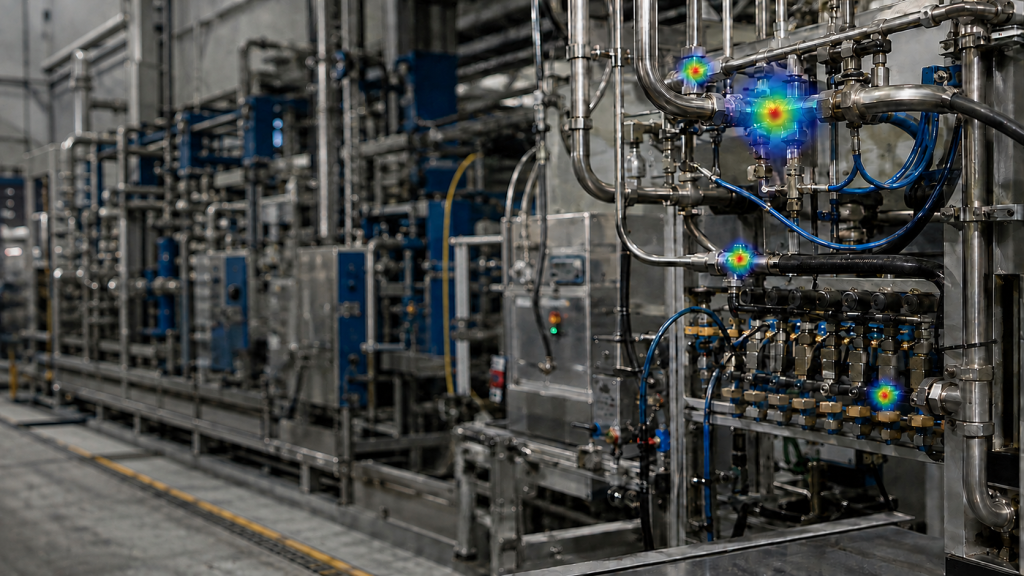
An acoustic imaging camera uses multiple microphones, acoustic signal processing and a visible-light camera to locate sound sources.
The microphone array receives sound from the surrounding environment.
Because the sound reaches different microphones with small differences in timing and intensity, signal-processing techniques such as beamforming can determine the direction from which the sound originates.
The camera then overlays the detected acoustic source onto the visible image.
Instead of simply hearing that a leak may be somewhere nearby, the technician can see where the acoustic signal is coming from.
This is what makes acoustic imaging particularly useful for industrial leak surveys.
From Point-by-Point Inspection to Area Scanning
The biggest workflow advantage of acoustic imaging is the ability to screen an area before moving closer to individual components.
Consider a production line containing:
- 80 pneumatic fittings
- 30 valves
- 20 flexible hoses
- 15 pneumatic cylinders
- Multiple regulators and couplings
With a point-by-point approach, technicians may need to move close to many potential leakage points individually.
With an acoustic imaging camera, they can first scan the wider system.
If a relevant acoustic source appears on the display, the technician can focus attention on that specific area.
This changes the maintenance question from:
“Which of these 145 components is leaking?”
to:
“The camera has identified an acoustic source around this valve assembly—what exactly is causing it?”
That is a much narrower problem to investigate.
- Acoustic Imaging Helps Technicians Find Unknown Leaks
Traditional leak detection can be straightforward when the approximate location of a leak is already known.
The challenge is finding unknown leaks.
A maintenance team may know that compressed-air consumption appears higher than expected but have no idea where the losses are occurring.
An acoustic camera allows technicians to walk through the facility and scan equipment for relevant acoustic sources.
This makes the technology particularly useful for:
- Initial plant surveys
- Large compressed-air systems
- Preventive maintenance routes
- Energy audits
- Pneumatic production lines
- Facilities with many possible leakage points
The camera helps narrow a large search area into specific locations requiring investigation.
- Larger Areas Can Be Screened Quickly
One of the main limitations of point-based inspection is coverage.
The technician must physically direct the detector toward potential leak locations.
An acoustic imaging camera provides visual information across its field of view.
This allows the user to examine multiple fittings or components within the same scene.
For example, a technician standing in front of a pneumatic manifold may be able to scan multiple valves and connections before approaching the suspected source.
For large industrial plants, this broader screening capability can reduce the time spent checking components that are not producing relevant acoustic signals.
- Leaks Can Be Located From a Distance
Some potential leakage points are difficult to access.
They may be:
- Above production machinery
- Behind safety barriers
- Along elevated pipework
- Inside restricted areas
- Around moving equipment
- Located in crowded utility spaces
Acoustic imaging allows sound sources to be located remotely within the capability of the instrument and the inspection environment.
This does not remove the need for safe working procedures.
However, it can reduce the need to approach every potential leak simply to determine whether an acoustic source is present.
The technician can first identify the area of interest and then determine the safest appropriate follow-up action.
- Acoustic Imaging Helps in Noisy Industrial Environments
Factories are noisy.
That makes leak detection by human hearing difficult.
A small compressed-air leak may be masked by motors, fans, pumps or production machinery.
Acoustic imaging systems can allow technicians to focus on selected frequency ranges and use signal-processing techniques to help separate relevant acoustic sources from background noise.
This is particularly important because compressed-air leaks can generate high-frequency acoustic energy.
By focusing on suitable frequency ranges, technicians may be able to locate leak-generated signals even when the environment contains significant audible noise.
Seeing Sound Changes the Inspection
This is one of the biggest differences between acoustic imaging and listening for a leak.
The technician does not have to determine direction using hearing alone.
The acoustic camera provides a visual indication.
When a relevant source is detected, the display effectively says:
“Investigate here.”
That can make the inspection process more intuitive.
- Multiple Potential Leaks Can Be Identified During One Survey
Industrial leak management is rarely about finding one leak.
A large facility may have many.
During a plant-wide acoustic survey, technicians can identify potential leakage points and document them as they move through the facility.
A typical inspection route could include:
Compressor room → Main air distribution → Production Line A → Production Line B → Packaging → Utilities
At each area, the technician scans for acoustic sources and records findings.
This creates a list of actionable maintenance locations rather than a general conclusion that “the compressed-air system has leaks.”
Turn Invisible Leaks Into Maintenance Tasks
Each finding can be documented with information such as:
- Asset identification
- Leak location
- Acoustic image
- Visible image
- Inspection date
- Repair priority
- Technician notes
Once leaks are documented, they can enter the normal maintenance workflow.
This is an important transition.
The leak changes from an invisible energy loss into a specific maintenance task.
- Acoustic Imaging Can Reduce Time Spent Confirming Non-Leaking Components
Inspection efficiency is not only about how quickly a leak is found.
It is also about how much time technicians spend checking components that are functioning normally.
Imagine inspecting 500 pneumatic fittings.
If only 20 are leaking, the maintenance challenge is identifying those 20 without spending excessive time on the other 480.
Area-based acoustic screening can help technicians focus their attention on locations producing relevant acoustic signals.
This makes maintenance resources more targeted.
The technology does not eliminate technician judgement, but it helps answer an important question:
“Where should I spend my inspection time?”
- Faster Documentation Supports Faster Repair
Finding the leak is only one part of the process.
Maintenance personnel also need to know:
- Where the leak is
- Which equipment is affected
- What needs to be investigated
- Which leaks should be prioritised
Visual acoustic documentation can make this communication easier.
Instead of writing:
“Possible air leak somewhere around Production Line 3 pneumatic system,”
the technician can record an acoustic image showing the suspected source around a specific fitting.
This can help repair personnel understand the location before beginning work.
A Faster Industrial Leak Detection Workflow
A structured acoustic imaging survey can follow six stages.
Step 1: Scan
Survey the equipment from an appropriate working position.
Look for relevant acoustic sources.
Step 2: Locate
Use the acoustic overlay to identify the approximate source.
Move closer where necessary and safe.
Step 3: Document
Capture the acoustic image and record the equipment location.
Step 4: Prioritise
Determine which findings require the earliest attention according to leak severity, operational importance and site procedures.
Step 5: Repair
Repair or replace the affected fitting, hose, valve, seal or other component.
Step 6: Verify
Scan the repaired location again.
Confirm whether the abnormal acoustic source remains.
The final verification step is important.
A completed maintenance work order does not necessarily prove that the leak has been eliminated.
Reinspection provides additional confirmation.
Acoustic Imaging vs Listening for Leaks
Listening is the simplest leak detection method.
For large leaks in quiet environments, it may be enough to identify a problem.
Industrial environments, however, are rarely quiet.
Listening
Advantages:
- Requires no specialised equipment
- Obvious large leaks may be easy to hear
Limitations:
- Difficult in noisy environments
- Direction can be difficult to determine
- Ultrasonic signals cannot be heard directly
- Inefficient for systematic plant-wide surveys
Acoustic Imaging
Advantages:
- Visually locates acoustic sources
- Can detect relevant high-frequency signals
- Screens larger areas
- Supports documentation
- Allows remote inspection within instrument capability
For structured industrial leak surveys, the visual localisation provided by acoustic imaging can significantly improve workflow.
Acoustic Camera vs Traditional Ultrasonic Leak Detector
Traditional ultrasonic detectors remain useful tools.
They typically detect ultrasonic sound and provide an audible or numerical indication to the technician.
The user then moves the instrument around the equipment to narrow down the leak location.
This can be highly effective for targeted inspection.
An acoustic imaging camera approaches the problem differently.
Instead of asking the technician to find the direction manually, it displays the acoustic source visually.
Traditional Ultrasonic Detector
A good fit when:
- The approximate leak location is known
- Detailed point-by-point inspection is required
- The technician is checking specific components
Acoustic Imaging Camera
A good fit when:
- Leak locations are unknown
- Large areas must be surveyed
- Many components need to be screened
- Inspection speed is important
- Visual documentation is useful
The technologies can complement one another rather than being mutually exclusive.
What Types of Industrial Leaks Can Acoustic Imaging Help Locate?
Compressed Air Leaks
One of the most common applications.
Escaping compressed air produces turbulent flow and acoustic energy that can be detected and located.
Pressurised Gas Leaks
Certain pressurised-gas leaks can generate acoustic signals that an acoustic camera can locate.
The camera detects the sound generated by the leak, not the chemical identity or concentration of the gas.
Appropriate gas-detection instrumentation and safety procedures remain necessary where required.
Vacuum Leaks
Air entering a vacuum system through an unintended opening can also generate acoustic signals.
Potential inspection points include seals, connections, fittings and vacuum lines.
Pneumatic System Leaks
Pneumatic valves, cylinders, hoses, regulators and fittings are common acoustic inspection targets.
Example: Plant-Wide Compressed Air Survey
Consider a manufacturing facility with several production lines.
The compressed-air system supplies:
- Pneumatic cylinders
- Automated machinery
- Packaging equipment
- Control valves
- Air tools
- Cleaning stations
Maintenance personnel suspect that compressed-air losses are increasing.
But the facility contains thousands of possible leak points.
Checking every connection individually would require significant labour.
Instead, a technician establishes an acoustic inspection route.
The technician walks through each production area with an acoustic imaging camera, scanning pipework and pneumatic equipment.
The camera identifies a strong acoustic source near a valve manifold.
The technician captures an image and records the location.
Farther along the production line, another source appears around a hose connection.
It is also documented.
The technician continues the survey without stopping to manually test every normal-looking fitting.
At the end of the route, the maintenance team has a targeted list of locations requiring investigation.
This is the main productivity advantage of acoustic imaging:
maintenance effort is concentrated where acoustic evidence indicates a potential problem.
Faster Leak Detection Can Support Energy Efficiency
Inspection speed matters because compressed-air leaks waste energy for as long as they remain unrepaired.
Compressed air requires electrical energy to produce.
If air escapes through leaks, the compressor has already consumed energy to create compressed air that performs no useful work.
Faster identification can shorten the time between:
Leak develops → Leak is discovered → Repair is scheduled → Leak is eliminated
For facilities with extensive compressed-air networks, routine acoustic surveys can therefore support broader energy-efficiency programmes.
Faster Does Not Mean Less Thorough
Acoustic imaging is not intended to encourage rushed inspections.
The objective is to make the search process more efficient.
Technicians still need to:
- Interpret acoustic information correctly
- Understand equipment operation
- Distinguish relevant signals from unrelated sound
- Follow safe working procedures
- Investigate suspected leaks
- Document findings
- Verify repairs
The camera helps reduce the time spent searching.
Technical judgement remains essential.
How to Improve Acoustic Leak Survey Efficiency
Create Repeatable Inspection Routes
Divide the facility into logical areas and inspect them consistently.
Know Your Compressed-Air Network
Understand where major distribution lines, pneumatic equipment and high-consumption users are located.
Use Appropriate Frequency Settings
Select frequency ranges suitable for the application and environment.
Scan Before Moving Closer
Begin with broader screening, then approach identified sources where safe and necessary.
Document Immediately
Record leak location and equipment information while still at the asset.
Prioritise Repairs
Not every leak needs to be treated with identical urgency.
Verify Repairs
Reinspect completed work.
Repeat Surveys
New leaks will develop as equipment ages, vibrates and undergoes maintenance.
A leak-management programme should therefore be continuous rather than a one-time exercise.
FOTRIC Acoustic Imaging for Faster Industrial Inspection
FOTRIC develops acoustic imaging solutions for industrial leak detection, compressed-air inspection and condition monitoring.
FOTRIC acoustic cameras use arrays of digital MEMS microphones combined with acoustic processing to visually locate sound sources.
Depending on the model and application, FOTRIC acoustic imaging solutions can support:
- Compressed-air leak detection
- Pressurised-gas leak detection
- Vacuum leak detection
- Pneumatic system inspection
- Mechanical acoustic inspection
- Partial discharge inspection
For maintenance teams responsible for large industrial facilities, visual acoustic localisation can help reduce the amount of time spent searching for unknown sound sources.
FOTRIC TD2e Acoustic Imaging Camera
The FOTRIC TD2e is designed as a portable acoustic imaging solution for industrial inspection.
Its microphone array detects acoustic signals and displays their location over the visible image.
For compressed-air and pneumatic inspection, technicians can use this visual information to scan equipment and identify suspected leakage locations.
This makes the camera suitable for maintenance teams that need a practical tool for routine acoustic inspection routes.
Advanced Acoustic Imaging for Larger Facilities
For more demanding industrial inspection programmes, higher-performance acoustic cameras can provide larger microphone arrays and additional evaluation capabilities.
Depending on the FOTRIC model, advanced features can support leak evaluation and help maintenance teams prioritise findings.
This becomes particularly valuable when a plant-wide survey identifies many potential leaks.
Finding 50 leaks is useful.
Knowing which ones should receive attention first makes the information more actionable.
Acoustic + Thermal Imaging for Multi-Purpose Maintenance
Leak detection is not the only inspection responsibility in most factories.
The same maintenance team may also inspect:
- Electrical panels
- Motors
- Bearings
- Transformers
- Mechanical equipment
These problems may require thermal rather than acoustic information.
A thermal camera visualises temperature.
An acoustic camera visualises sound.
For teams responsible for both types of condition monitoring, combined acoustic-thermal imaging can provide a broader inspection approach.
The technician can use acoustic imaging for leaks and sound localisation while using thermal imaging for temperature abnormalities.
From Searching for Leaks to Managing Leaks
The biggest benefit of acoustic imaging is not simply that it produces a colourful sound map.
Its value comes from changing the maintenance workflow.
Traditional leak detection can become a search problem:
Where is the leak?
Acoustic imaging helps turn that into an action problem:
We have located the suspected leak. What should we do about it?
That difference matters.
The less time technicians spend searching, the more time the maintenance organisation can spend:
- Repairing confirmed problems
- Verifying completed work
- Inspecting additional assets
- Analysing recurring failures
- Improving compressed-air efficiency
Make Invisible Leaks Easier to Find
Industrial leaks are often invisible.
They may also be difficult to hear and difficult to reach.
Acoustic imaging converts the sound generated by a leak into visual information that maintenance teams can use.
By allowing technicians to scan larger areas, locate unknown acoustic sources from a distance and document findings visually, acoustic cameras can make industrial leak detection faster and more systematic.
The goal is not simply to find one leak quickly.
It is to create a repeatable process that allows maintenance teams to find more leaks, prioritise them, repair them and verify the results efficiently.
That is where acoustic imaging can deliver significant value for industrial maintenance.
Looking for an Acoustic Imaging Camera for Industrial Leak Detection in Singapore?
Atlantis Technologies provides FOTRIC acoustic and thermal imaging solutions in Singapore for industrial leak detection, compressed-air inspection, predictive maintenance and condition monitoring.
Whether you need to locate compressed-air leaks across a manufacturing plant, inspect pneumatic equipment, investigate pressurised-gas or vacuum leaks, or establish a structured acoustic inspection programme, our team can help identify an appropriate FOTRIC solution.
Explore our FOTRIC Thermal & Acoustic Camera solutions or contact Atlantis Technologies at sales@atlantistech.com.sg to discuss your industrial leak-detection requirements.