

Thermal Imaging for Building Inspection: Detecting Moisture and Heat Loss
Building problems are not always visible.
Moisture can develop behind finishes before obvious staining appears. Missing or deteriorated insulation can create unexpected temperature differences. Air leakage around doors, windows and building-envelope penetrations can increase cooling or heating demand without leaving any obvious visual sign.
A thermal imaging camera for building inspection gives facility managers, engineers and building professionals another way to investigate these hidden conditions.
Instead of seeing only the physical surface of a wall, ceiling, roof or HVAC component, a thermal camera visualises differences in surface temperature.
These thermal patterns can help inspectors identify areas requiring further investigation for problems such as:
- Moisture intrusion
- Insulation deficiencies
- Air leakage
- Heat gain or heat loss
- HVAC problems
- Roof anomalies
- Building-envelope defects
- Electrical overheating
The key is understanding what thermal imaging actually shows—and what it does not.
What Is Thermal Imaging for Building Inspection?
A thermal imaging camera detects infrared radiation emitted by surfaces and converts that information into a thermal image.
Different temperatures appear as different colours or shades according to the selected palette.
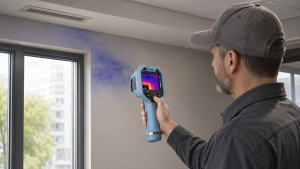
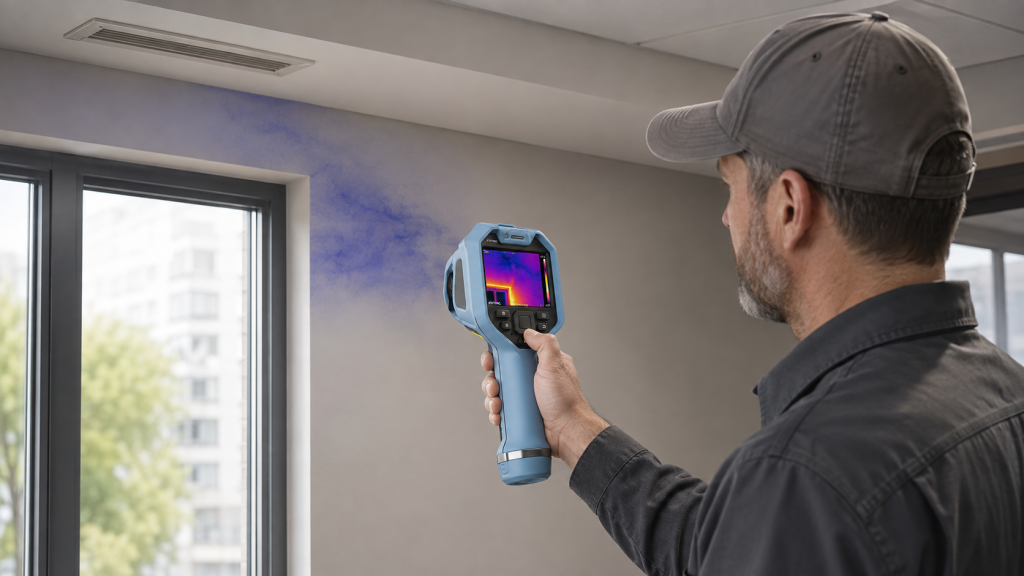
For example, an inspector can scan a wall that appears completely uniform to the naked eye.
The thermal image may reveal an area with a noticeably different surface temperature from its surroundings.
That temperature difference is an indication.
The inspector then considers the building construction, environmental conditions and other evidence to determine what may be causing it.
Thermal imaging therefore works particularly well as a screening and diagnostic tool.
It helps answer:
“Where should I investigate more closely?”
- Detecting Possible Moisture with Thermal Imaging
One of the most common questions about building thermography is:
Can a thermal camera detect moisture?
The technically correct answer is:
A thermal camera does not directly detect water or moisture.
It detects surface temperature.
However, moisture can sometimes create temperature patterns that differ from surrounding dry building materials.
This can occur because of factors including evaporation and differences in thermal behaviour between wet and dry materials.
As a result, thermal imaging can help inspectors locate suspicious areas that may warrant moisture testing.
What Might Moisture Look Like on a Thermal Image?
Depending on environmental conditions and the building material, a moisture-related area may appear cooler or otherwise thermally different from its surroundings.
Potential locations include:
- Walls
- Ceilings
- Roof areas
- Areas around windows
- Plumbing routes
- HVAC systems
- Areas below bathrooms
- Areas around building penetrations
The pattern itself is not proof that moisture is present.
Other conditions can produce similar thermal patterns.
That is why thermal imaging should be used to locate the anomaly, followed by confirmation with appropriate inspection methods.
Thermal Camera + Moisture Meter
A useful building-inspection workflow is:
Thermal Scan → Identify Suspicious Area → Verify with Moisture Meter → Investigate Source
The thermal camera can help screen a relatively large surface quickly.
A moisture meter can then be used at selected locations to determine whether elevated moisture is actually present.
This combination can be much more efficient than randomly checking large wall or ceiling areas point by point.
- Finding Hidden Water Intrusion
Water can enter buildings through many locations.
Possible sources include:
- Roof leaks
- Plumbing leaks
- Failed waterproofing
- Window seals
- Façade defects
- Condensation
- HVAC systems
- Pipework
- Bathrooms and wet areas
By the time water staining becomes visually obvious, the affected area may already be significant.
Thermal imaging can sometimes reveal temperature anomalies associated with affected materials before the full extent of the problem is apparent visually.
This can help building professionals narrow the inspection area.
For example, a ceiling may show only a small visible stain.
The thermal image may reveal a broader temperature pattern extending beyond the visible mark.
That information can help determine where additional moisture measurements should be taken.
- Detecting Heat Loss and Heat Gain
Buildings exchange heat with their surroundings.
Where unwanted heat transfer occurs, the HVAC system may need to work harder to maintain comfortable indoor conditions.
Thermal imaging can help visualise these temperature differences.
In colder climates, thermography is commonly associated with finding areas where heat escapes from a heated building.
In Singapore and other tropical climates, the perspective is often reversed.
A major concern is unwanted heat entering an air-conditioned building.
Potential problem areas can include:
- Roofs
- External walls
- Windows
- Doors
- Poorly insulated areas
- Building-envelope penetrations
- Thermal bridges
Thermal imaging can help facility teams identify unusual temperature patterns that may indicate where heat is being transferred through the building envelope.
Why This Matters in Singapore
Singapore’s climate creates a different building-energy challenge from colder countries.
Air-conditioning is a major building load.
If unwanted external heat enters conditioned spaces because of insulation, glazing, sealing or envelope problems, cooling systems may need to remove that additional heat.
For local building inspections, it is therefore useful to think about both:
heat loss from conditioned spaces
and
heat gain from the outdoor environment.
- Identifying Insulation Problems
Insulation is designed to reduce heat transfer.
When insulation is missing, damaged, compressed or incorrectly installed, surface temperatures can differ from properly insulated areas.
A thermal camera can make these differences visible under suitable environmental conditions.
Potential applications include inspecting:
- Walls
- Roofs
- Ceilings
- Ductwork
- Cold rooms
- Insulated pipework
- Building-envelope systems
Imagine a wall with insulation installed between structural elements.
Visually, the entire finished wall appears identical.
Under suitable temperature conditions, thermal imaging may reveal an area with a different temperature pattern where insulation is missing or performing differently.
This allows inspectors to target further investigation rather than opening building finishes randomly.
- Detecting Air Leakage
Uncontrolled air leakage can affect:
- Indoor comfort
- HVAC efficiency
- Humidity control
- Building pressure
- Energy consumption
Common leakage locations can include:
- Window frames
- Doors
- Wall penetrations
- Service openings
- Roof interfaces
- Joints in the building envelope
When there is a sufficient temperature difference between incoming air and surrounding surfaces, thermal imaging may help reveal the resulting thermal patterns.
Air leakage inspection is particularly effective when thermography is combined with appropriate building-testing techniques.
The thermal camera helps visualise where the effect of air movement appears to be occurring.
- Inspecting HVAC Systems
Thermal imaging is also useful inside the building.
HVAC systems are responsible for maintaining temperature and comfort, making them natural candidates for thermal inspection.
Applications can include:
- Air-conditioning supply
- Ductwork
- Diffusers
- Fan-coil units
- Chilled-water systems
- Pipe insulation
- Cooling coils
- Mechanical rooms
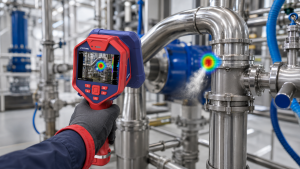
Thermal imaging can help technicians identify unexpected temperature patterns and compare similar equipment.
For example, poorly insulated chilled-water pipework may produce a different surface-temperature pattern from correctly insulated sections.
Likewise, unusual temperature distribution around an HVAC component can indicate where further mechanical investigation is required.
- Inspecting Roofs for Thermal Anomalies
Roofs are exposed continuously to weather, solar radiation and moisture.
Problems involving waterproofing or insulation can affect the thermal behaviour of roofing materials.
Under suitable inspection conditions, thermography may reveal temperature differences across a roof surface that warrant further investigation.
Potential applications include:
- Flat-roof inspection
- Waterproofing investigation
- Insulation assessment
- Moisture-related investigation
- Roof maintenance surveys
Environmental conditions are particularly important for roof thermography.
Solar loading, rain, wind and the timing of the inspection can significantly affect results.
A thermal anomaly should therefore be interpreted in context and confirmed using appropriate methods.
- Detecting Thermal Bridges
A thermal bridge is an area where heat moves through the building envelope more readily than through surrounding materials.
This can occur around:
- Structural elements
- Window systems
- Concrete sections
- Metal framing
- Building joints
- Connections between different construction materials
Thermal bridges can affect building energy performance and may also contribute to localised condensation risk under certain conditions.
Thermal imaging helps visualise the temperature patterns associated with these areas.
- Inspecting Electrical Systems Inside Buildings
Building thermography is not limited to walls and roofs.
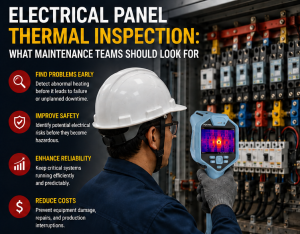
Facility teams can use the same thermal camera for electrical maintenance.
Common inspection targets include:
- Distribution boards
- Switchboards
- Circuit breakers
- Cable connections
- Busbars
- Electrical terminals
- Transformers
- Motor control equipment
Abnormal electrical resistance or loading conditions can create unusual temperature patterns.
This makes thermal imaging useful for both building diagnostics and electrical preventive maintenance.
- Finding Problems Without Destructive Investigation
One of the major benefits of thermal imaging is its non-contact nature.
Consider a large wall with a suspected moisture problem.
Without additional information, inspectors may need to choose locations for invasive testing based on limited visual evidence.
A thermal scan can help identify suspicious temperature patterns first.
The inspector can then focus further testing on specific areas.
This does not make thermography completely “non-destructive” in every investigation because follow-up testing may still be necessary.
But it can help reduce unnecessary exploratory work.
What Thermal Cameras Cannot See
Understanding the limitations of thermal imaging is just as important as understanding its benefits.
Thermal Cameras Cannot See Through Walls
A thermal camera measures infrared radiation reaching the camera from surfaces.
It does not provide X-ray vision.
It cannot simply see pipes, water or insulation hidden inside an opaque wall.
Instead, hidden conditions may influence the temperature of the visible surface.
The camera detects that resulting temperature pattern.
Thermal Cameras Do Not Directly Detect Moisture
A thermal image may show an anomaly associated with moisture.
But temperature differences can have many causes.
Moisture should be verified with suitable testing equipment.
Thermal Cameras Do Not Automatically Identify the Cause
A cold area might result from:
- Moisture
- Air movement
- Insulation differences
- HVAC effects
- Construction details
- Reflections
- Other environmental factors
The inspector must interpret the thermal pattern using knowledge of the building.
Inspection Conditions Matter
Building thermography depends heavily on environmental conditions.
Temperature difference, solar loading, wind, rain, HVAC operation and inspection timing can all influence the image.
Indoor vs Outdoor Thermal Building Inspection
Both perspectives can provide useful information.
Indoor Inspection
Useful for:
- Moisture investigation
- Air leakage
- HVAC performance
- Ceiling anomalies
- Internal wall inspection
- Electrical inspection
Indoor inspections often provide easier access and more controlled conditions.
Outdoor Inspection
Useful for:
- Building-envelope assessment
- Roof inspection
- Façade anomalies
- Thermal bridging
- Heat-transfer investigation
External inspections can be strongly affected by solar radiation, weather and reflections.
The appropriate inspection approach depends on the objective.
Why Timing Matters
A thermal image represents conditions at a particular moment.
For building inspections, timing can dramatically change what the camera sees.
For example, a sun-exposed external wall may remain warm long after direct sunlight has moved away.
If the inspector does not account for solar loading, that stored heat could be mistaken for a building defect.
Similarly, recent rainfall can affect surface temperatures.
Wind can cool surfaces.
HVAC operating conditions can change indoor thermal patterns.
Good building thermography therefore requires planning rather than simply walking around with a camera.
Common Thermal Imaging Mistakes in Building Inspection
Assuming Every Cold Spot Is Moisture
A cold thermal pattern is not proof of a water leak.
Verify suspicious areas.
Ignoring Reflections
Glass, polished metals and other low-emissivity surfaces can reflect infrared radiation.
Inspecting Immediately After Strong Solar Heating
Solar loading can create significant thermal patterns unrelated to defects.
Ignoring HVAC Conditions
Air-conditioning can strongly influence interior surface temperatures.
Using Poorly Focused Images
Good focus is essential for thermal detail and temperature measurement.
Relying Only on the Colour Palette
Colours are relative to the displayed temperature scale.
Inspect actual temperature patterns and measurement data rather than assuming red always means “bad” and blue always means “moisture.”
Skipping Visual Documentation
Always capture visible images alongside thermal findings where practical.
This makes anomalies easier to locate later.
A Practical Building Thermal Inspection Workflow
A systematic inspection process improves consistency.
Step 1: Define the Problem
What are you investigating?
Moisture?
Heat gain?
Insulation?
HVAC performance?
Air leakage?
Electrical problems?
Step 2: Review Building Conditions
Understand construction, recent weather, HVAC operation and relevant environmental conditions.
Step 3: Conduct a Visual Inspection
Look for:
- Staining
- Cracks
- Damaged seals
- Condensation
- Deteriorated insulation
- Building-envelope defects
Step 4: Perform the Thermal Scan
Scan systematically rather than only examining obvious problem areas.
Step 5: Identify Anomalies
Compare suspicious areas with surrounding surfaces and similar building elements.
Step 6: Document
Capture thermal and visible images.
Record location and relevant environmental conditions.
Step 7: Verify
Use appropriate instruments or inspection methods.
For suspected moisture, this may include a moisture meter.
Step 8: Investigate the Root Cause
Determine why the abnormal condition exists.
Step 9: Repair
Complete appropriate building, waterproofing, HVAC, insulation or electrical work.
Step 10: Reinspect
Thermal imaging can help assess conditions after corrective action.
Thermal Imaging for Energy Audits
Thermal imaging can also support building energy assessments.
A building’s energy performance depends on many systems, including:
- HVAC
- Building envelope
- Insulation
- Windows and glazing
- Doors
- Electrical systems
- Controls
Thermography provides visual information about temperature distribution across these systems.
For example, an energy auditor may use thermal imaging to identify areas with unusual heat transfer and then investigate whether building-envelope improvements are justified.
The thermal camera does not calculate the building’s complete energy consumption.
Instead, it helps reveal where energy-related problems may be occurring.
Thermal Imaging for Facility Management
Facility managers often need one inspection technology to support multiple maintenance tasks.
A professional thermal camera can potentially be used for:
Building envelope:
Investigating heat transfer and insulation.
Moisture screening:
Locating suspicious thermal patterns for verification.
HVAC:
Investigating cooling and temperature distribution.
Electrical maintenance:
Identifying abnormal electrical heating.
Mechanical equipment:
Monitoring motors, pumps and bearings.
This versatility makes thermal imaging particularly useful for facility-management teams responsible for both building systems and equipment.
Choosing a Thermal Camera for Building Inspection
Several specifications should be considered.
Thermal Sensitivity
Building applications often involve subtle temperature differences.
A camera with good thermal sensitivity can reveal more detailed thermal patterns.
Infrared Resolution
Higher detector resolution provides more thermal detail and can be useful when inspecting larger building areas or smaller targets.
Wide-Angle Lens
Building interiors often provide limited working distance.
A wide-angle lens can make it easier to capture walls, ceilings and HVAC equipment in confined spaces.
Focus
Good focus is important for thermal detail.
Autofocus can improve inspection efficiency.
Measurement Capability
Professional building inspections benefit from reliable temperature measurement and adjustable parameters.
Reporting Software
Inspection findings should be documented clearly with thermal images, visible images, measurements and notes.
Portability
For building surveys involving multiple floors or large facilities, camera ergonomics and battery life become important practical considerations.
FOTRIC Thermal Cameras for Building and Facility Inspection
FOTRIC provides professional thermal imaging solutions suitable for industrial maintenance, electrical inspection, facility management and building-diagnostic applications.
Depending on the inspection requirement, FOTRIC thermal cameras provide combinations of:
- High-resolution infrared imaging
- High thermal sensitivity
- Temperature measurement
- Autofocus
- Visible-light imaging
- Multiple lens options
- Thermal analysis
- Reporting capabilities
For building inspection, camera selection should consider the expected temperature differences, target size, inspection distance and required field of view.
A facility team performing general HVAC, electrical and building inspections may have different requirements from a professional thermographer performing detailed building-envelope diagnostics.
Thermal Imaging in Singapore’s Tropical Climate
Many online thermography examples focus on buildings in winter climates.
Singapore requires a different perspective.
Instead of concentrating only on keeping heat inside a building, local facilities often need to prevent excessive heat gain while maintaining effective air-conditioning.
Relevant thermal inspection applications can include:
- Air-conditioned building envelopes
- Roof heat gain
- External wall temperature
- Window and glazing performance
- HVAC distribution
- Chilled-water systems
- Pipe insulation
- Moisture intrusion
- Condensation-related investigations
Singapore’s high humidity also makes moisture management important.
However, high humidity, solar loading and small indoor-to-outdoor temperature differences can make thermal interpretation more challenging.
Inspection conditions should therefore be selected carefully.
Thermal Imaging Makes Invisible Temperature Differences Visible
A wall can look perfectly normal while displaying an unusual temperature pattern.
A ceiling can show only a small stain while the surrounding thermal anomaly extends farther.
An insulated surface can appear visually uniform even when one section behaves differently.
This is where thermal imaging provides value.
It does not replace building knowledge, moisture meters, HVAC testing or other diagnostic methods.
Instead, it gives inspectors another layer of information:
temperature distribution.
That information helps facility teams decide where to investigate.
Detect Building Problems Earlier
Moisture, insulation deficiencies, HVAC problems and unwanted heat transfer can become expensive when left unidentified.
The challenge is finding them efficiently.
Thermal imaging provides a fast, non-contact method for screening large building areas and locating temperature anomalies that may indicate problems requiring further investigation.
When combined with good inspection technique and appropriate verification tools, thermography can support:
- Building maintenance
- Energy efficiency
- Moisture investigation
- HVAC troubleshooting
- Electrical maintenance
- Preventive maintenance
- Facility management
The objective is not simply to produce colourful thermal images.
It is to find abnormalities earlier, investigate more efficiently and make better maintenance decisions.
Looking for a Thermal Imaging Camera for Building Inspection in Singapore?
Atlantis Technologies provides FOTRIC thermal and acoustic imaging solutions in Singapore for building inspection, facility maintenance, HVAC troubleshooting, electrical inspection and predictive maintenance.
Whether you need to investigate suspected moisture, identify unusual heat gain, inspect insulation, troubleshoot HVAC systems or perform electrical thermography, selecting the right thermal camera depends on factors such as thermal sensitivity, infrared resolution, field of view and inspection conditions.
Our team can help identify an appropriate FOTRIC thermal imaging solution for your building and facility inspection requirements.
Explore our FOTRIC Thermal & Acoustic Camera solutions or contact Atlantis Technologies at sales@atlantistech.com.sg to discuss your building inspection application.