

Thermal Imaging Camera for Predictive Maintenance: A Practical Guide for Industrial Facilities
Industrial equipment rarely fails without warning.
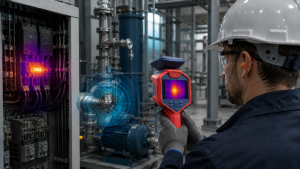
Before an electrical connection, motor, bearing or other component develops into a serious failure, there may be changes in temperature that indicate abnormal operating conditions. The challenge for maintenance teams is identifying these warning signs early—without shutting down equipment or dismantling machinery.
This is where thermal imaging cameras have become valuable tools for predictive and preventive maintenance.
By visualising temperature differences across equipment and electrical systems, thermal imaging allows maintenance professionals to identify abnormal heat patterns and investigate potential problems before they develop into costly failures.
What Is a Thermal Imaging Camera?
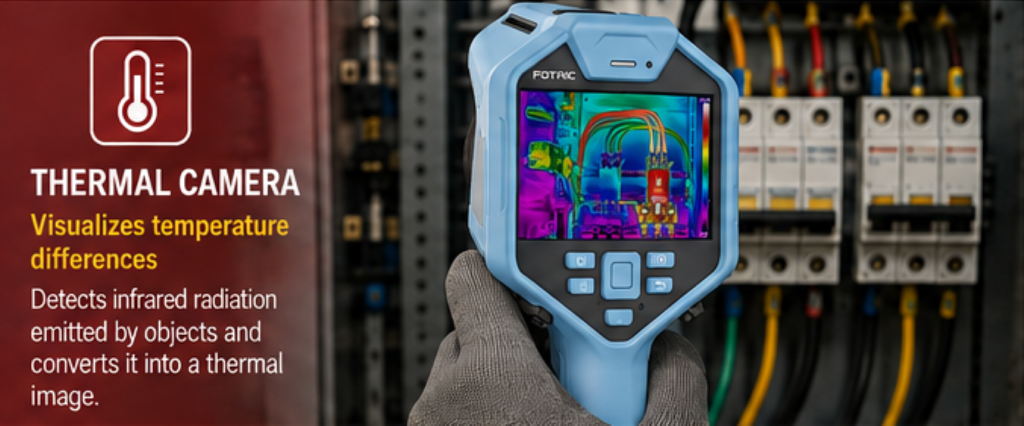
A thermal imaging camera detects infrared radiation emitted by objects and converts this information into a visual thermal image.
Instead of showing only what equipment looks like to the human eye, a thermal camera displays differences in surface temperature.
This allows maintenance engineers to quickly compare components and identify areas operating at unusually high or low temperatures.
Unlike conventional contact temperature measurements, thermal imaging is a non-contact inspection method, making it particularly useful when inspecting energised electrical equipment, moving machinery or equipment that is difficult to access.
Why Is Thermal Imaging Useful for Predictive Maintenance?
Traditional maintenance approaches often rely on scheduled servicing or responding after equipment has already developed a problem.
Predictive maintenance takes a different approach.
The objective is to monitor equipment condition and identify signs of deterioration early enough for maintenance teams to investigate and plan corrective action.
Thermal imaging supports this approach because many equipment problems can produce abnormal temperature patterns.
Instead of waiting for equipment to stop operating, maintenance teams can identify suspicious thermal behaviour during routine inspections and investigate further.
- Detecting Overheating Electrical Connections
Electrical systems are one of the most common applications for industrial thermal imaging.
Loose or deteriorating electrical connections can develop increased resistance, which may generate abnormal heating.
Using a thermal camera, technicians can inspect equipment such as:
- Electrical switchboards
- Distribution panels
- Circuit breakers
- Busbars
- Fuses
- Cable connections
- Terminals
- Transformers
A connection that appears significantly hotter than comparable components operating under similar conditions may require further investigation.
Finding these temperature anomalies during routine inspection can help maintenance teams address potential problems before they result in unplanned shutdowns or equipment damage.
- Identifying Electrical Load Problems
Thermal imaging can also help technicians compare temperature patterns across electrical phases and components.
Unexpected temperature differences may indicate conditions that warrant further examination, including load imbalance or abnormal component behaviour.
The advantage is speed: instead of taking individual temperature measurements at numerous points, technicians can scan a wider area and immediately identify locations requiring closer attention.
- Inspecting Motors and Mechanical Equipment
Electrical systems are not the only equipment that can benefit from thermal inspection.
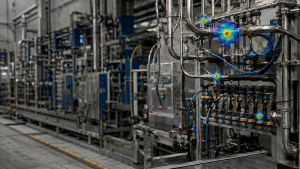
Motors, pumps and rotating machinery can also exhibit temperature changes when operating conditions deteriorate.
Maintenance teams can use thermal images to compare similar equipment or monitor how the temperature profile of an asset changes over time.
When combined with other condition-monitoring methods, thermal imaging provides another useful source of information for maintenance decision-making.
- Supporting Safer Inspections
One important advantage of infrared inspection is its non-contact nature.
Technicians can perform thermal observations from a distance rather than physically touching the component being measured.
This can be particularly valuable when inspecting operating electrical and industrial equipment.
Thermal imaging does not replace appropriate electrical safety procedures, PPE or risk assessments, but it can provide maintenance teams with additional information without requiring contact temperature measurement.
- Finding Problems That Are Difficult to See
Many developing equipment problems are not immediately visible.
An electrical terminal may appear perfectly normal while operating at a significantly different temperature from neighbouring connections.
A conventional visual inspection might therefore reveal nothing unusual.
A thermal image adds another layer of information by allowing technicians to see temperature distribution across the equipment.
This is why thermal imaging and conventional visual inspection work particularly well together.
Thermal Imaging and Condition-Based Maintenance
The real value of thermal imaging becomes greater when inspections are performed consistently.
Instead of treating each thermal image as an isolated measurement, maintenance teams can establish inspection routes and periodically examine critical equipment.
Historical observations can then help teams recognise changes in equipment behaviour.
For example, if the same electrical connection shows progressively increasing temperature differences during successive inspections under comparable operating conditions, maintenance personnel have additional evidence to prioritise further investigation.
This transforms a thermal camera from a troubleshooting instrument into a condition-monitoring tool.
Where Can Thermal Imaging Be Used?
Industrial thermal imaging has applications across numerous industries and facilities.
Common applications include:
Manufacturing Plants
Thermal cameras can support inspection of electrical distribution equipment, motors, production machinery and other critical assets.
Power and Electrical Utilities
Infrared inspection can be used for equipment such as substations, transformers, switchgear and electrical connections.
Commercial and Industrial Buildings
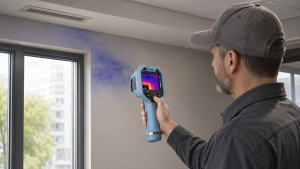
Thermal imaging can assist building professionals in investigating temperature anomalies associated with insulation, moisture intrusion and HVAC performance.
Research and Development
Engineers can use thermal imaging to visualise heat distribution when evaluating electronic components, prototypes and product designs.
Oil & Gas and Process Industries
Thermal imaging can form part of broader inspection and condition-monitoring programmes for electrical and process equipment.
Thermal Imaging vs Point Temperature Measurement
An infrared thermometer measures temperature at a specific point.
A thermal imaging camera provides an image containing temperature information across a much larger area.
This distinction can make thermal imaging considerably more efficient for inspection work.
If a technician does not know exactly where an abnormal hotspot is located, checking equipment point-by-point can be time-consuming.
A thermal camera allows the technician to scan the equipment first, identify areas of interest and then perform more detailed analysis.
Choosing an Industrial Thermal Imaging Camera
Not every thermal camera is designed for the same application.
When evaluating a camera for industrial inspection, several factors should be considered.
Infrared Resolution
Higher detector resolution provides more thermal measurement points and greater image detail, which can be particularly useful when inspecting smaller components or equipment from greater distances.
Thermal Sensitivity
Thermal sensitivity describes the camera’s ability to distinguish small temperature differences.
Higher sensitivity can help reveal subtle thermal patterns.
Measurement Accuracy
For professional inspection applications, temperature measurement performance and appropriate measurement procedures are important considerations.
Focusing System
Depending on the inspection environment, manual, automatic or fixed-focus systems may affect inspection speed and image clarity.
Reporting and Analysis
For maintenance programmes, capturing an image may only be the beginning.
Software and reporting capabilities can help teams document findings, analyse measurements and maintain inspection records.
FOTRIC Thermal Imaging Solutions
FOTRIC develops thermal and acoustic imaging technologies for industrial inspection, predictive maintenance, R&D and other professional applications.
Its thermal imaging portfolio includes solutions ranging from compact inspection cameras to professional and high-performance thermal imaging systems, as well as R&D and fixed-mount solutions.
For organisations that also perform compressed air, gas or vacuum leak inspections, FOTRIC offers acoustic imaging solutions that allow technicians to visualise the location of sound sources.
Thermal and acoustic technologies can therefore address different aspects of an industrial condition-monitoring programme.
Thermal Imaging and Acoustic Imaging: Complementary Technologies
Thermal imaging detects temperature patterns.
Acoustic imaging detects and visualises sound sources.
That difference makes the two technologies suitable for different maintenance problems.
For example, a maintenance team may use thermal imaging to investigate abnormal heating in an electrical switchboard while using acoustic imaging to locate compressed air leaks elsewhere in the facility.
Rather than viewing them as competing inspection methods, industrial organisations can incorporate both technologies into a broader predictive-maintenance strategy.
Building a Thermal Inspection Programme
Purchasing a thermal camera is only the first step.
For better results, organisations should develop a consistent inspection process.
This can include identifying critical assets, establishing inspection routes, defining suitable inspection intervals, recording operating conditions, maintaining historical thermal images and establishing procedures for investigating abnormalities.
Training is equally important. Understanding emissivity, reflections, viewing angles, distance and equipment loading conditions can help users interpret thermal measurements correctly.
Bringing Greater Visibility to Industrial Maintenance
Predictive maintenance depends on information.
The earlier maintenance teams can recognise abnormal equipment behaviour, the more opportunity they have to investigate the cause and plan appropriate corrective action.
Thermal imaging provides a fast, visual and non-contact way to add temperature information to industrial inspections.
For electrical maintenance, mechanical inspection, building diagnostics, R&D and broader condition-monitoring applications, it can help engineers see information that conventional visual inspection alone cannot reveal.
Looking for a FOTRIC Thermal Imaging Camera in Singapore?
Atlantis Technologies provides FOTRIC thermal and acoustic imaging solutions for industrial inspection and condition-monitoring applications.
Whether your requirement involves electrical inspection, predictive maintenance, equipment troubleshooting, R&D, building inspection or acoustic leak detection, our team can help identify an appropriate solution for your application.
Explore our FOTRIC Thermal & Acoustic Camera solutions or contact Atlantis Technologies at sales@atlantistech.com.sg to discuss your inspection requirements.